

What the World Cup did to the American workday ⚽


Envoy's latest data drop looks at workplace entry data across more than 300 U.S. metro areas during the World Cup's knockout rounds, from the Round of 16 through the Final, to see what the biggest sporting event ever staged on American soil actually did to the American workday. Originally published July 15, 2026, this post has been updated with the semifinals (7/14-15) and final (7/19) data.
Earlier this year, we put "Super Sick Monday" under the microscope and found a real but modest effect: workplace entries dipped 1.87% the Monday after Super Bowl LIX. A collective sniffle, not a shutdown.
Then the World Cup came home. And across the knockout rounds, the data tells a very different story: attendance rhythms that held steady through most of the tournament, and one morning when they didn't.
The shape of the knockout window
Zooming out across the full stretch from July 4 through the Final and the Monday after, the tournament's workplace footprint looks less like a rolling disruption and more like a single sharp dent.

The clearest signal in the daily series isn't any single match, it's the shape of the recovery. Entries bottomed out on Knockout Tuesday and then climbed back in an almost straight line, from nearly 26% down to roughly flat within a week, and stayed at or above baseline the rest of the way. The World Cup read as a single shock followed by a steady return to normal, not a string of escalating disruptions.
Weekday attendance ran modestly below seasonal norms early in the window. This was also the post-July 4 vacation stretch, when even a matchless Wednesday ran about 8% light.
Weekday matches came and went with attendance largely intact: Portugal vs Spain on a Monday afternoon in Dallas, a Thursday quarterfinal in Foxborough, a Friday-noon quarterfinal in Los Angeles, and a Tuesday-afternoon semifinal in Dallas.
By the second week, attendance had recovered to slightly above its seasonal baseline. Weekend match days sat right on their usual baselines, and buildings stayed open the entire window, with the number of active workplaces barely moving day to day. The tournament even closed quietly.
The third-place match in Miami on Saturday, July 18 landed on its usual Saturday baseline, and the Final itself in New York and New Jersey on Sunday, July 19 came in essentially flat nationally, at plus 0.3%
Then there's Tuesday, July 7.
Knockout Tuesday: the morning after the USMNT's elimination
The U.S. Men's National Team played Belgium in the Round of 16 on Monday, July 6: an 8pm ET kickoff in Seattle, a primetime national audience, and a 4-1 loss that ended the co-host's tournament.
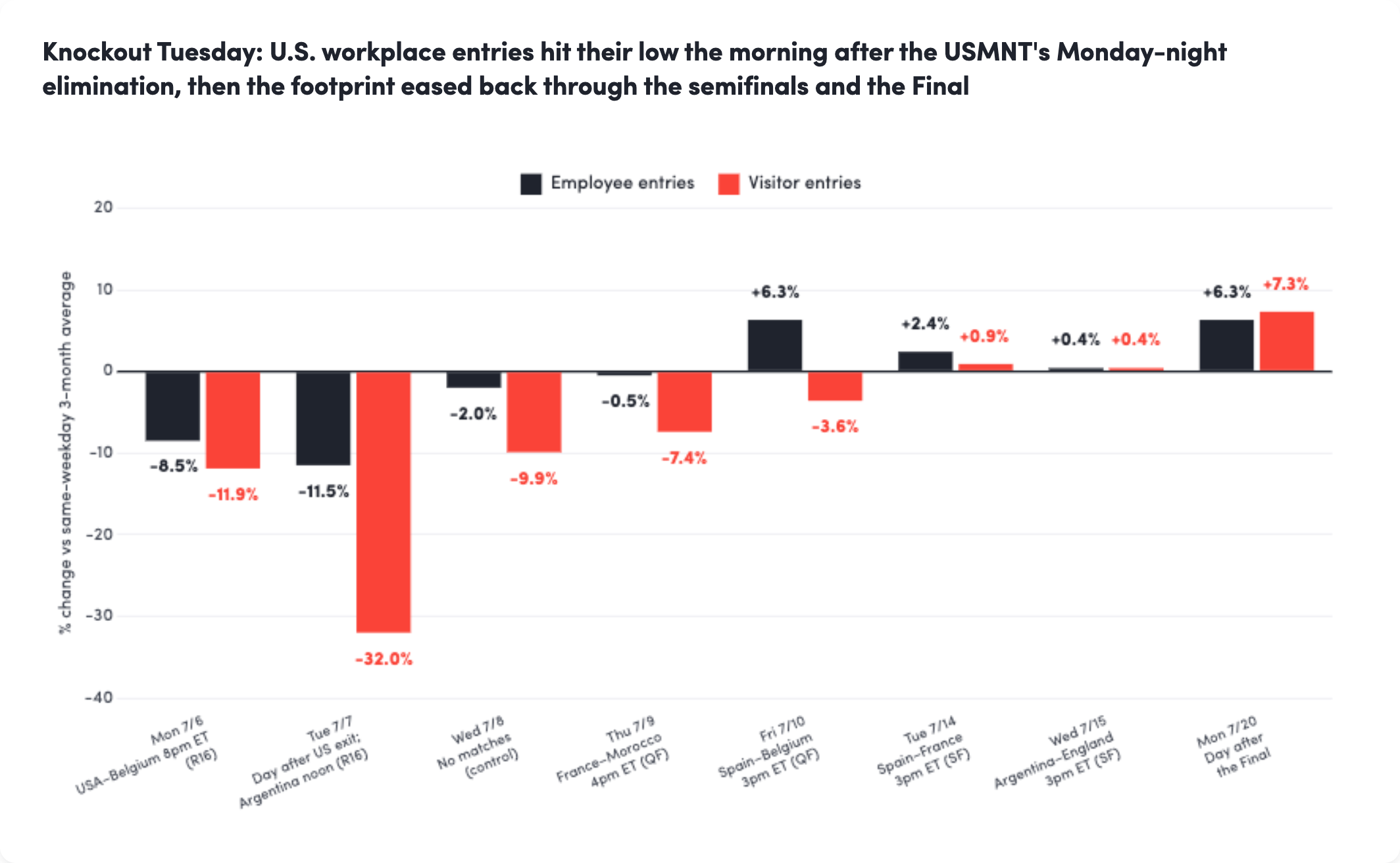
On Monday itself, offices mostly held their breath: entries ran about 11% below typical Monday levels, a few points softer than the rest of the week. Tuesday was something else. Total workplace entries fell nearly 26% below typical Tuesday levels, roughly 18 points deeper than that same week's no-match control day. Put against our Super Bowl benchmark, the morning after the USMNT was knocked out hit the American workplace roughly ten times harder than Super Sick Monday.
And it wasn't offices going dark. Active workplaces barely budged from Monday to Tuesday. Each open office was simply quieter, fewer badge-ins, fewer guests, thinner floors.
A meeting story more than an absence story
Here's the detail workplace teams should care about most: employees and visitors behaved completely differently.
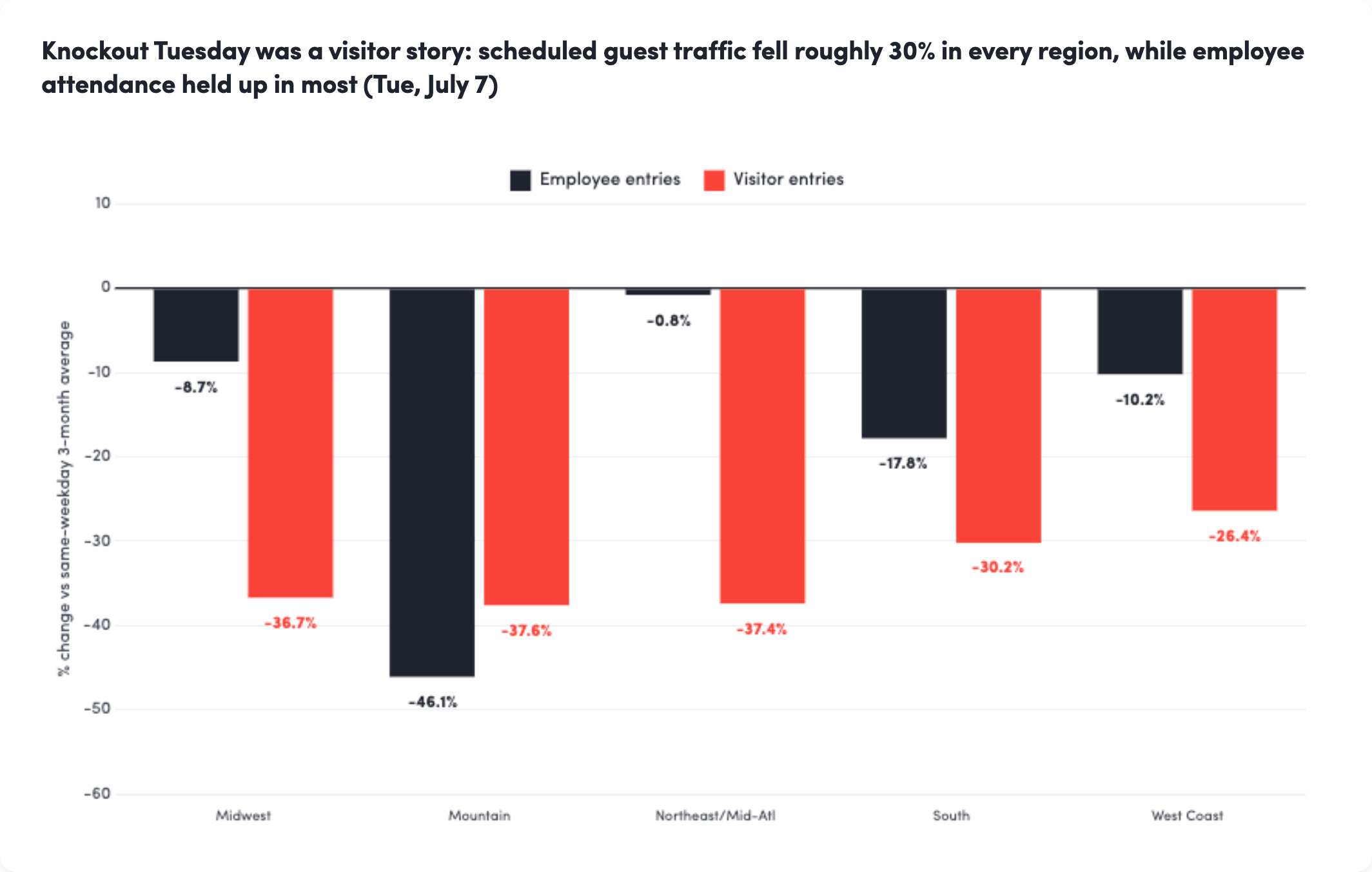
Employee entries on Knockout Tuesday dipped 11.5%, real but survivable. Visitor entries fell 32%, nearly three times as much, and the drop was remarkably uniform from coast to coast. Every region we track saw scheduled guest traffic fall between 26% and 38%. State by state, the pattern held too. Every sizable state dipped relative to its own baseline that day, with no regional cluster among the most affected. Georgia was the steepest, though Atlanta hosted a noon match (Argentina vs Egypt) that Tuesday, so its dip combines the nationwide morning-after effect with its own match-day emptying of the visitor lobby.
In other words, most employees dragged themselves in. What thinned out was everything on the calendar: client visits, interviews, vendor meetings. When a big game runs late on a Monday night, Tuesday's meetings are the first casualty, often cancelled, or simply never booked in the first place.

Host cities showed up. Then they slept in.
When we studied the Super Bowl, the pattern was clear: the hangover hit hardest where the game was won, hosted, and celebrated. The World Cup flipped that on its head, at least on match day.
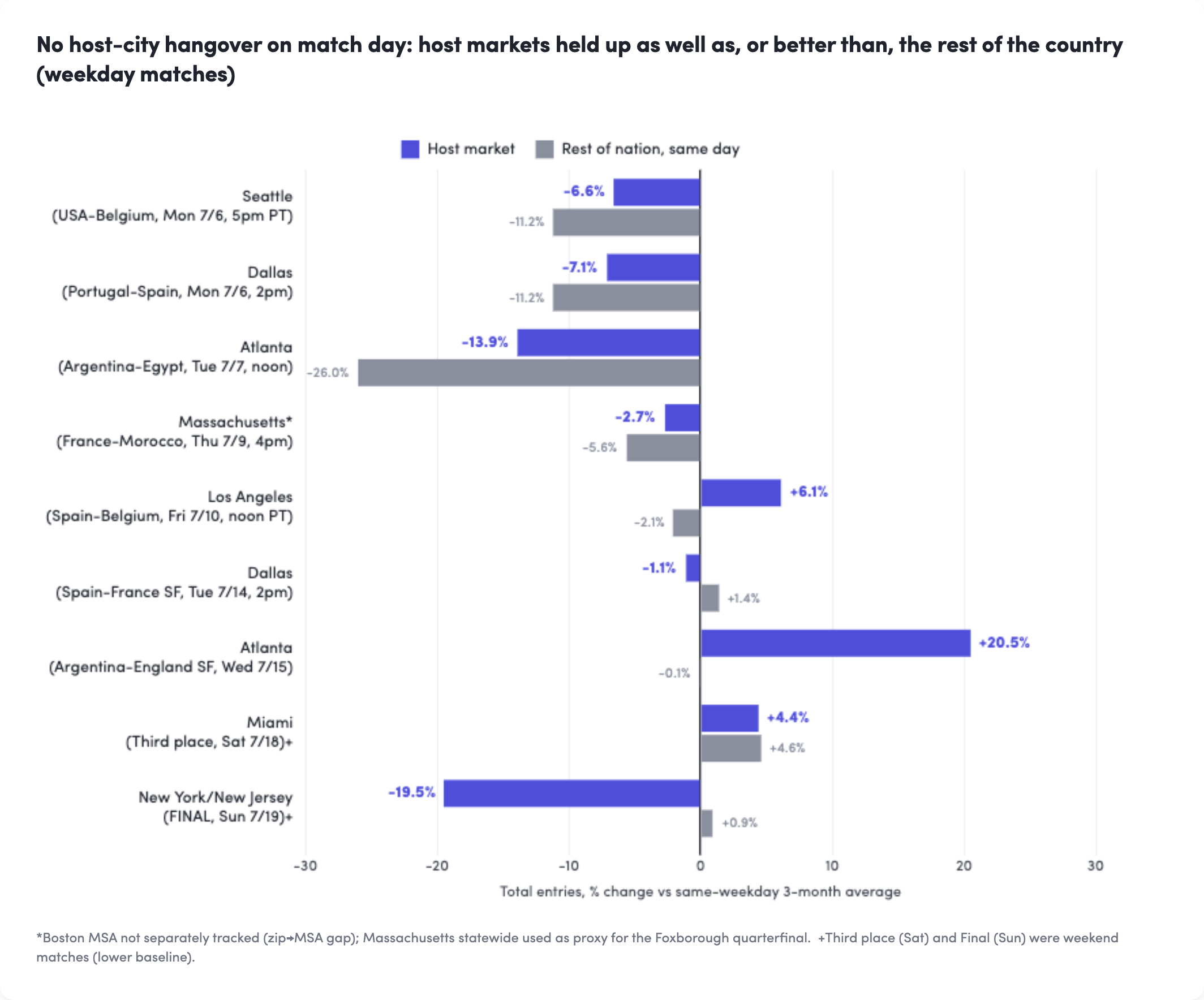
Across every weekday match in the window, the host market held up as well as, or better than, the rest of the country while the game was in town.
Seattle ran 6.8% below baseline on USA vs Belgium day while the nation ran 9.8% below. Dallas, hosting Portugal vs Spain at 2pm, looked the same.
Los Angeles actually beat its baseline, up 6.1%, while hosting a Friday-noon quarterfinal. The Dallas semifinal held to the pattern too: hosting Spain vs France on a Tuesday afternoon, Dallas ran essentially flat, down 1.2%, while the nation ran slightly ahead of baseline.
Atlanta's semifinal was the clearest home-market surge of the whole tournament. With Argentina and England in town on a Wednesday, Atlanta ran 20.5% above baseline while the rest of the country sat flat. A World Cup match, it turns out, doesn't empty a host city's offices. It fills the city.
The exception proves the rule. The one place with a true morning-after was the city that hosted the U.S. match. Seattle was nearly normal on game day, then posted its worst weekday of the entire window the next morning, down 20.4%. The celebration effect we saw with the Super Bowl still exists. It just belonged to the team, not the trophy, and it arrived a day late.

One more host-city wrinkle: midday kickoffs didn't keep host-city employees home, but they did clear the visitor lobby. Atlanta's noon match saw visitor entries drop 41%, the metro's only down day of the whole window, and the Boston-area quarterfinal, a 4pm kickoff, saw visitor traffic run 21% light even as employee entries ran above normal. Nobody skips work for someone else's match. They just don't schedule guests into a host city on match day.
The one genuine exception came on the last day. New York and New Jersey, hosting the Final on a Sunday, dipped below baseline while the rest of the nation held flat. That is a weekend marquee-event effect, with people heading for the stadium and the watch parties rather than the office, not the weekday held-up pattern the rest of the window told. What happened in that metro the next morning is the tournament's real closing note.
No hometown-hero effect
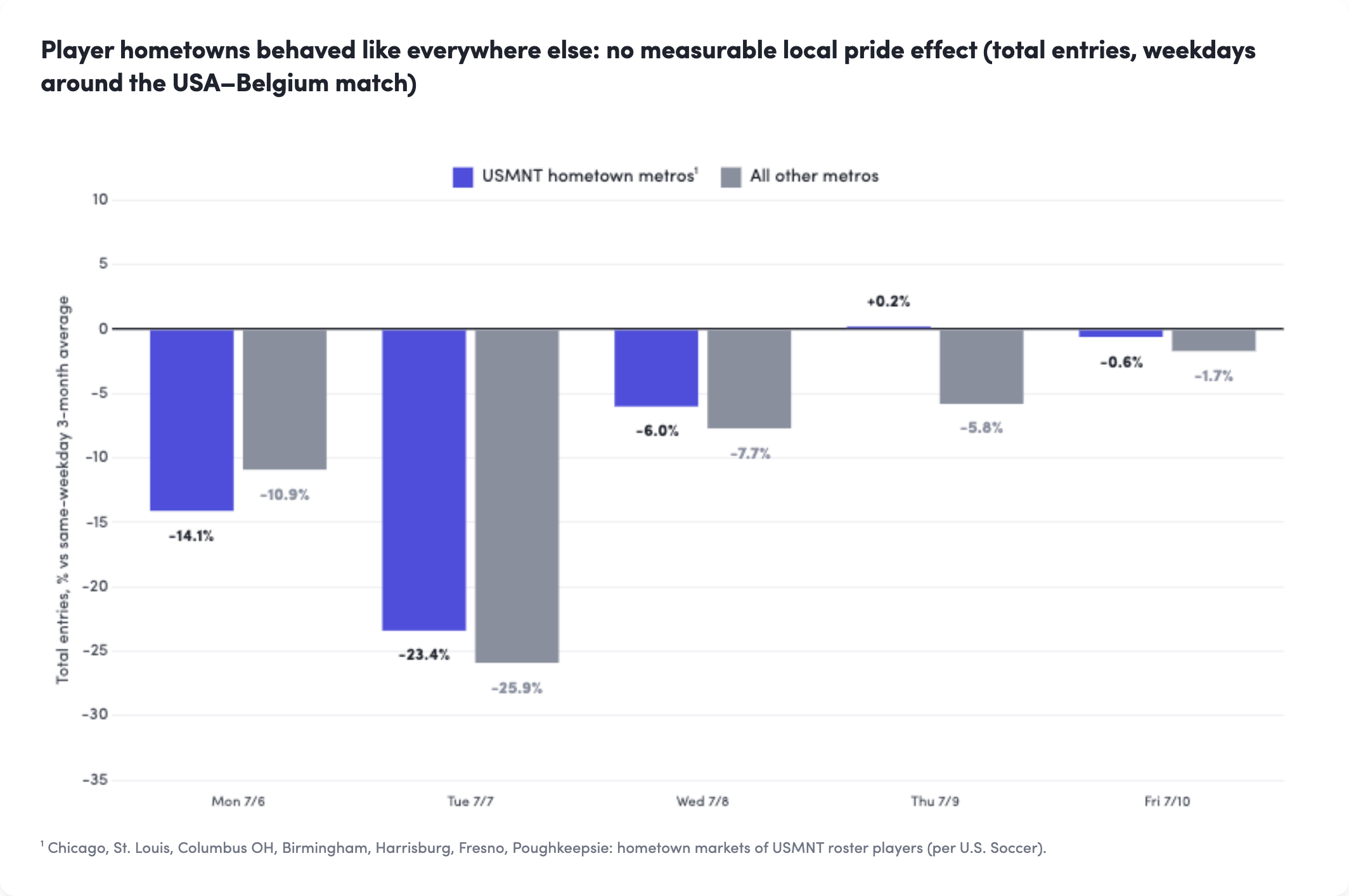
We checked whether the hometowns of USMNT players, from Christian Pulisic's Hershey, Pennsylvania to Weston McKennie's Dallas suburbs to Tim Ream's St. Louis, behaved differently around the U.S. match. They didn't. Player hometown metros tracked the national numbers within a couple of points all week. National-team fandom, at least as measured by office attendance, is genuinely national.
Bigger rounds, smaller national footprint
You might expect the workplace impact to build as the tournament escalated: quarterfinals bigger than the Round of 16, semifinals bigger still, the Final biggest of all. The data shows the opposite.
Once the USMNT went out, the national effect eased round by round. From Monday's 11% dip and Tuesday's 26%, the first quarterfinal Thursday softened to 5.5%, Friday's Spain vs Belgium quarterfinal registered 1.7%, and Saturday's two quarterfinals landed right on baseline.
The semifinals confirmed it, with the Spain vs France semifinal in Dallas on Tuesday, July 14 coming and going while the nation ran slightly above its seasonal baseline, up 1.3%. And the Final settled it. The single biggest match of the tournament, Spain against Argentina for the trophy with no U.S. team on the field, left national attendance flat at plus 0.3%. The biggest round of all produced the smallest national footprint.

That's not to say the remaining teams don't move people. France, Spain, Argentina, and England packed stadiums, lifted host-city activity, and reshaped visitor calendars in the markets where they played. But their pull showed up locally, in the host cities, rather than as a nationwide attendance shift. Through the Final, the workplace impact followed who was playing, and specifically whether it was the U.S., far more than the size of the round.
How it ended: the morning after that wasn't
The Final landed in the New York area on Sunday, July 19, where Spain beat Argentina at MetLife Stadium to lift the trophy. The question we had been watching all tournament was whether the Monday after would bring a Super-Sick-Monday-style dip. It didn't. National workplace entries on Monday, July 20 ran plus 7.0%, not just free of any hangover but slightly above a typical Monday.
The clearest test was the host city itself. New York and New Jersey had emptied out on Final Sunday, down 19.5% against a national read of plus 0.3%, as people headed for the stadium and the watch parties. If any market was primed for a Monday hangover, it was this one. Instead the New York and New Jersey metro ran plus 10.3% on Monday, July 20, ahead of both its own norm and the national plus 7.0%. The city that skipped the office for the Final was busier than usual the very next workday. The only morning-after the American workplace actually felt this tournament was the one that followed the U.S. team's own elimination, back on Knockout Tuesday.
If there's one thing this tournament proved, it's that when the U.S. team plays, and especially when its run ends, the American workweek feels it the next morning, everywhere at once, mostly in the meetings that never happen. When someone else lifts the trophy, the country goes back to work the next day like nothing happened, and so does the city that hosted the party. Plan your calendars accordingly. And maybe don't book the big client visit for the morning after the next USMNT knockout game.
—
This post is part of our Data Snack Series. Check out past blogs for more workplace insights.
Read more
Envoy’s September 2026 releases help teams manage visitors with less manual work, streamline compliance reporting, and keep access systems in sync.
Learn how to measure conference room utilization, occupancy, no-shows, booking density, and more, and use the data to make smarter space decisions.
Envoy’s August 2026 releases introduce Envoy Response for emergency management, bringing emergency response into the same platform you already use for visitor and workplace management.

Envoy's July 2026 releases focus on workplace intelligence features like HRIS directory sync, workplace map file exports, and mailroom management improvements through the Developer API.

Envoy Academy is back with a full refresh. Still free, still on-demand, and organized by role so admins get fluent in Envoy fast.
Envoy's June 2026 releases help you close gaps between physical and digital systems with smarter visitor data controls, seamless move management, and real-time workplace intelligence.