

Is “Super Sick Monday” real? What 2025 workplace data reveals for Super Bowl 2026


Every year, the Monday after the Super Bowl gets its own reputation. Super Sick Monday. The idea that offices empty out after a night of football, food, and late celebrations.
So we took a closer look at workplace entry data around Super Bowl LIX, played on Sunday, February 9, 2025 in New Orleans, to see what actually happened once Monday morning rolled around.
The answer is yes, Super Sick Monday is real, but it is far more nuanced than the myth suggests.
A small dip, not a national hangover
Across the U.S., workplace entries dipped -1.87% on Monday, February 10 compared to surrounding Mondays. That is a real decline, but a small one. Most people still showed up, and work largely went on as usual. So the Super Sick Monday of lore is less like a nationwide shutdown, and more like a mild, collective sniffle.

For context, one week later, on Presidents Day, workplace entries dropped by roughly 40% nationwide, reflecting the impact of a true, calendar-driven day off.
That comparison is important. It shows that while the Super Bowl does influence how people show up to work, it does not come close to the effect of an actual holiday. Super Sick Monday is not a mass call-out. It is a modest, measurable shift in attendance.
Where the confetti didn’t quite settle
The impact becomes much clearer in markets where the Super Bowl actually meant something, especially places tied to the teams and the celebration itself.
On the Monday after the Super Bowl:
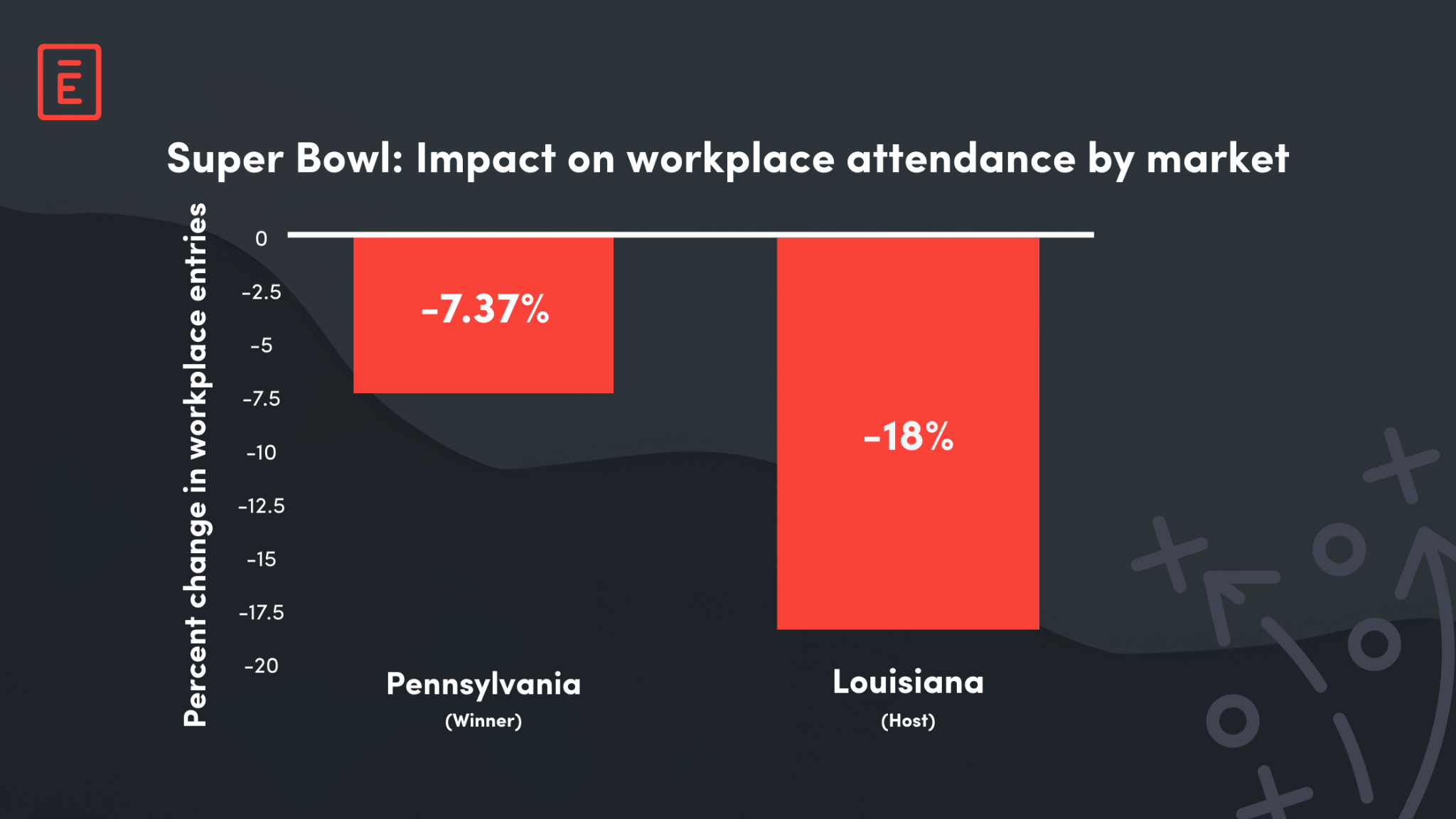
- Pennsylvania, home to the winning Philadelphia Eagles, saw a -7.37% drop in total workplace entries
- Louisiana, the host state, saw an even larger -18% drop in total entries
In both cases, workplaces were simply quieter. Fewer employees showed up on-site. Fewer visitors were scheduled. Meetings shifted, calendars lightened, and activity slowed.
That pattern makes intuitive sense. Winning the Super Bowl, or hosting it, brings late nights, parades, watch parties, and extended celebrations. The celebratory hangover is not just physical. It is cultural. Super Sick Monday hits hardest where the Super Bowl was won, hosted, and celebrated the most.
What happens without a celebration effect
Chiefs fans and Midwesterners may already know this, but as a quick refresher: the Kansas City metro spans two states, Missouri and Kansas. For simplicity, we’ll refer to this region as the Kansas City metro throughout.
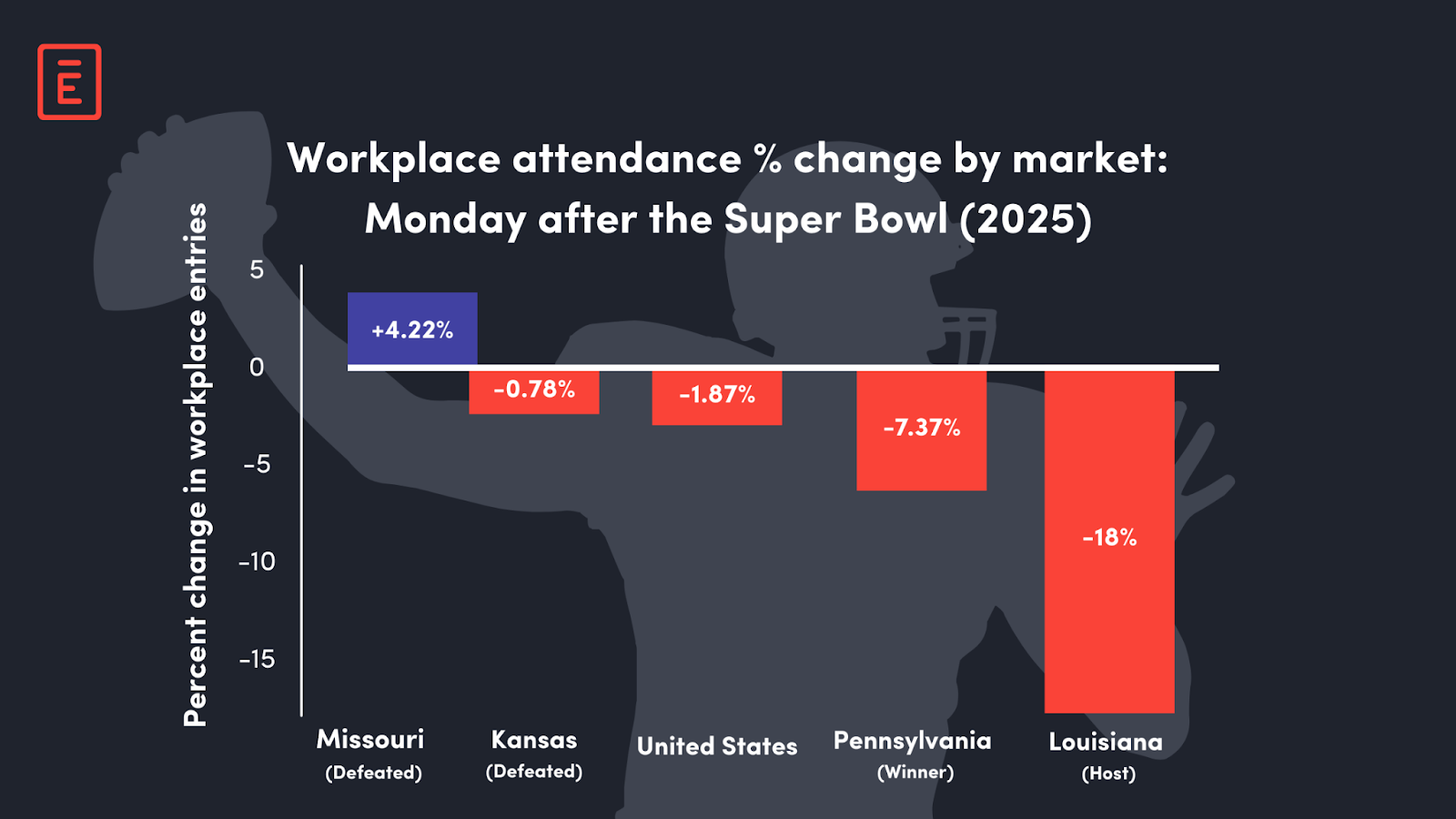
Only a modest 0.78% decrease in workplace attendance was observed on the Monday after the Super Bowl on the Kansas side of the metro.
Meanwhile, Missouri-based workplaces, where the Chiefs are headquartered, actually saw an increase in workplace entries on February 10 (+4.22%). Taken together, the Kansas City metro’s workplace activity stayed close to normal, and in some places, even ticked up.
That may feel counterintuitive given the hype. The Kansas City metro had plenty of reasons for a late night. The Chiefs were on the sport’s biggest stage, and attention around the game was especially high, with even Taylor Swift in attendance to watch Travis Kelce play. If excitement alone drove people to stay home on Monday, Kansas City might have been primed for it.
But the data suggests a different motivation. Without a win to celebrate or a host city buzzing with post-game events, Kansas City’s workday snapped back quickly. Compared to the nationwide employee dip of 1.87%, the metro looked much closer to business as usual. In other words, when there’s no parade to attend, some people may head back to work a little sooner, if only to put the loss behind them. While winners and hosts celebrate, the losers—well, they go back to their day jobs.
What can we expect to see after Super Bowl 2026?
The Super Bowl may only last a few hours, but its impact on the workweek can linger. How much it lingers, though, depends on your connection to the game’s location and the outcome. Winning and hosting on Sunday do appear to extend the celebration into Monday, but without that celebration effect, even the biggest game of the year does not meaningfully slow the workday.
Looking ahead to 2026, that means workplaces in the San Francisco Bay Area, especially in and around Santa Clara, should plan for a noticeably quieter Monday after the Super Bowl, with fewer employees on-site and lighter visitor traffic. The same is likely to hold true in the winning team’s home market, where celebrations tend to run a little longer into the previous night.
Additional insights from 2025 workplace data
Knowing when people show up has become just as important as knowing where they sit. Anticipating on-site patterns makes it easier to plan everything that keeps workplaces running smoothly, from space utilization and staffing to security, food service, and front-desk coverage.
The good news is that workplace behavior in 2025 is no longer unpredictable. Attendance now follows clear, repeatable rhythms across days of the week, cities, and industries. These patterns show up consistently, giving workplace teams a reliable foundation to plan around instead of guessing week to week.
Below are a few of the key trends we’re seeing in 2025 workplace data, and what they reveal about how flexible, hybrid work has truly settled in.
Trend 1: The 3-day work week is cemented
Hybrid work has settled into a predictable rhythm. Attendance is no longer spread evenly across five days, and the traditional five-day in-office workweek has effectively disappeared.
Key trends to watch:
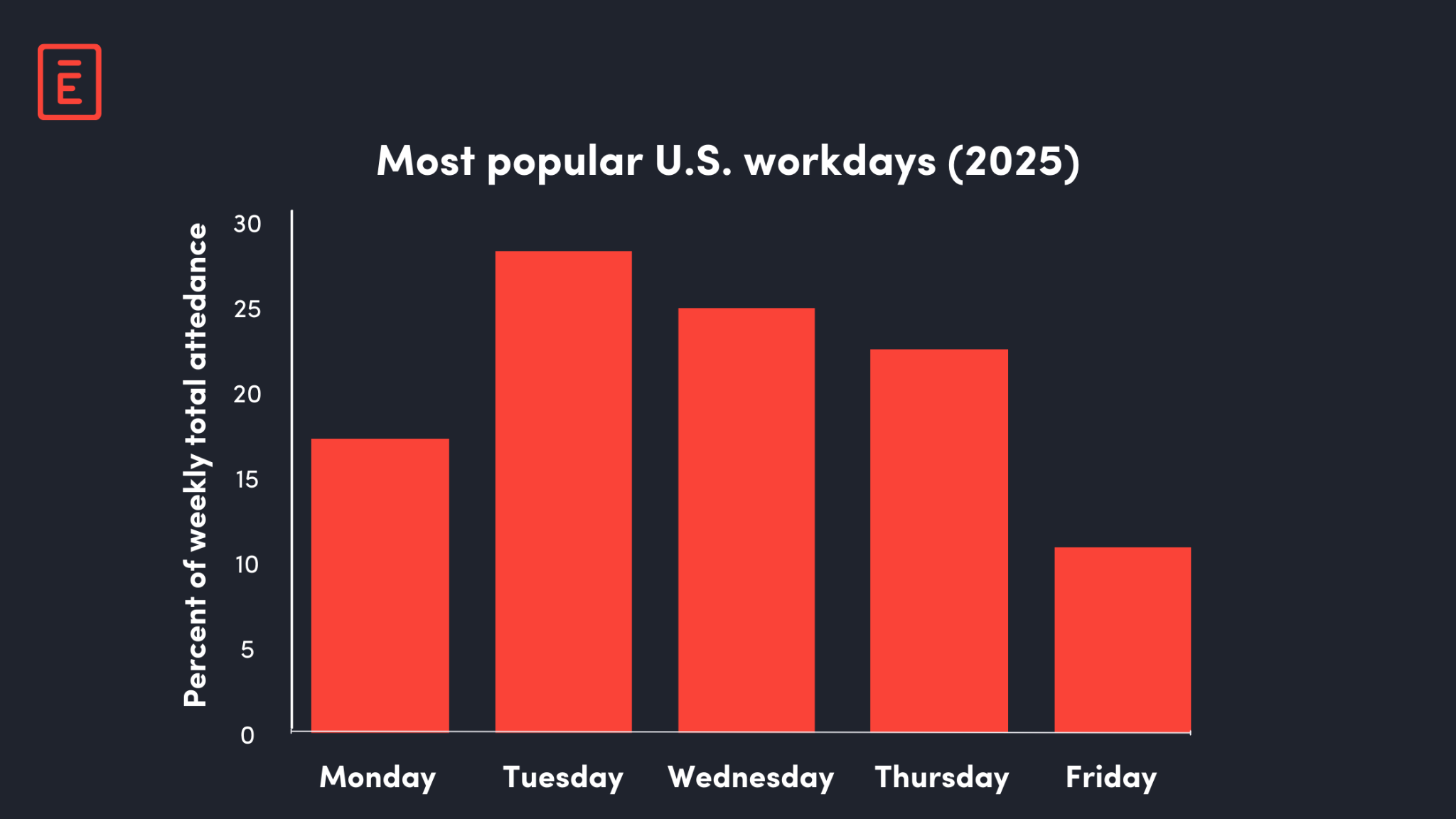
- Tuesday and Wednesday now anchor the office week. Across industries, Tuesday is the single busiest day for on-site work, with Wednesday close behind. Together, these two days account for nearly 50% of all weekly workplace activity, making midweek the clear center of gravity for in-person collaboration.
- Monday has shifted into a true ramp-up day. Offices are not empty, but they are noticeably quieter. Attendance on Mondays is 37.5% lower than Tuesday’s peak, suggesting employees increasingly use Mondays for heads-down or remote work before coming in for collaboration later in the week.
- Thursday, meanwhile, has quietly become the real third office day. Attendance on Thursdays remains strong, outperforming Monday by 41%. In practice, the modern three-day workweek runs from Tuesday through Thursday.
- By Friday, the office all but clears out. Across 100% of industries analyzed, Friday is the least-attended weekday with a 59.5% decline from Tuesday’s high. For most industries, meaningful in-office activity effectively wraps up by Thursday afternoon. This aligns closely with patterns we’ve previously shared in our analysis of Summer Fridays, where lighter Friday attendance showed up consistently, even outside of formal seasonal policies. In practice, many organizations are already treating Fridays as flexible, year-round.
Trend 2: Geography can shape when people show up
While midweek dominates everywhere, which day peaks depends on where you are. That means national workplace hybrid policies may have a regional nuance, meaning that the “best” in-office day for everyone might change based on where you are located.
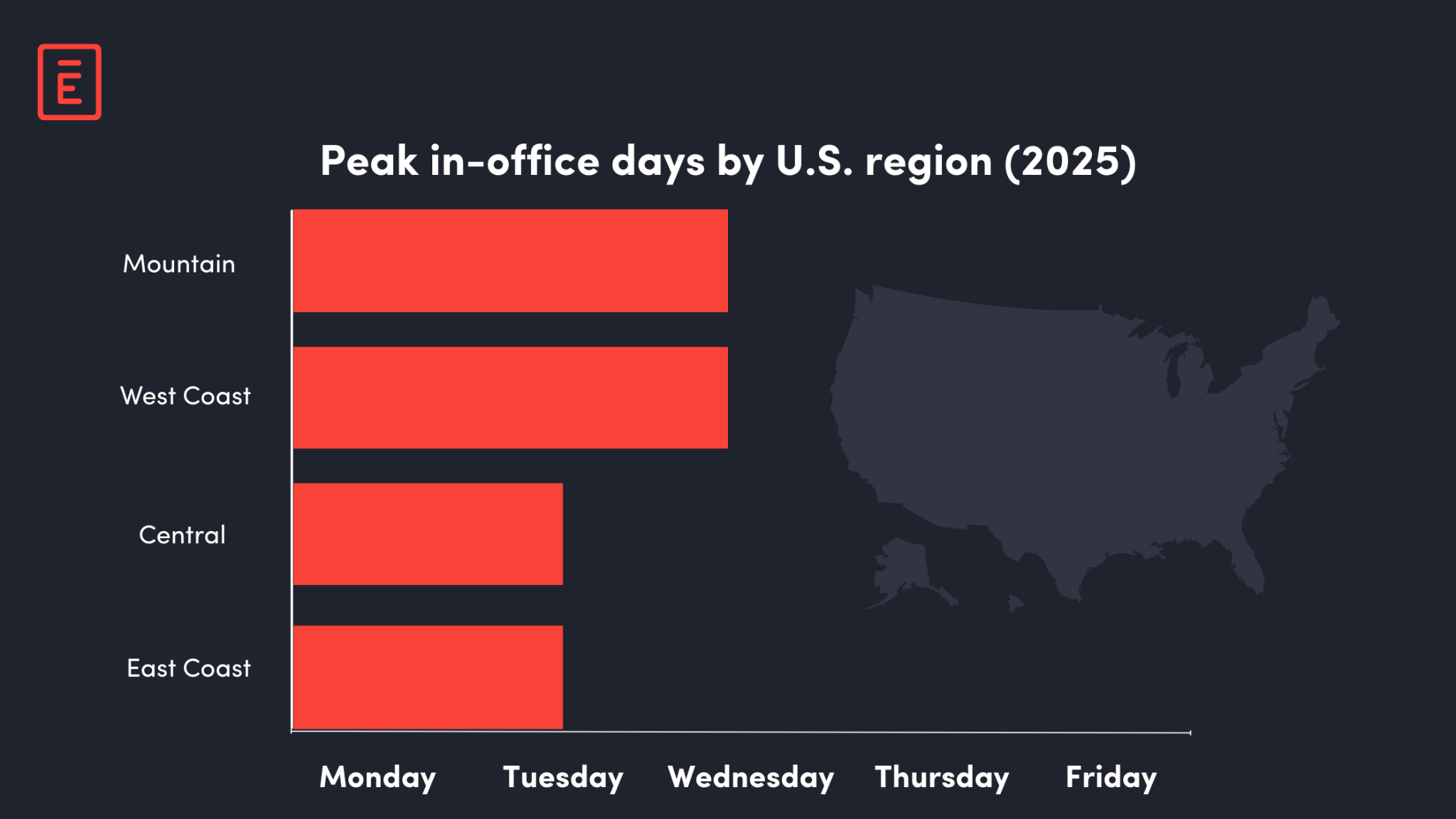
Key trends to watch:
- Tuesday is the clear favorite for East Coast and Central cities (New York, Boston, Chicago, DC, Atlanta).
- Wednesday is the dominant day for West Coast and Mountain hubs (San Francisco, Los Angeles, Denver, Portland).
Trend 3: Industry matters, even in hybrid work
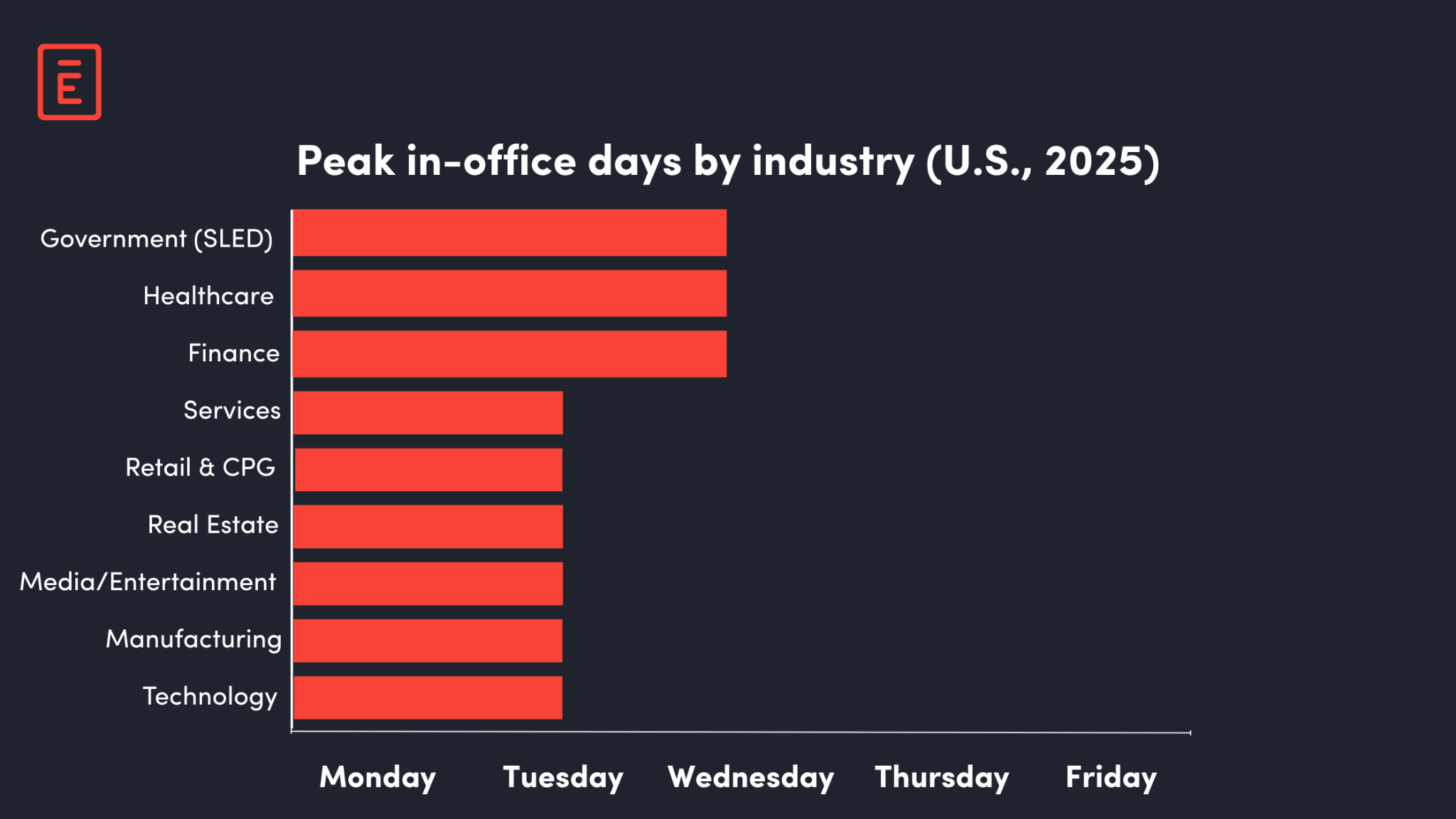
Key trends to watch:
- Finance, Healthcare, and Government peak on Wednesday
- Technology, Manufacturing, Media, Real Estate, Retail, and Services peak on Tuesday
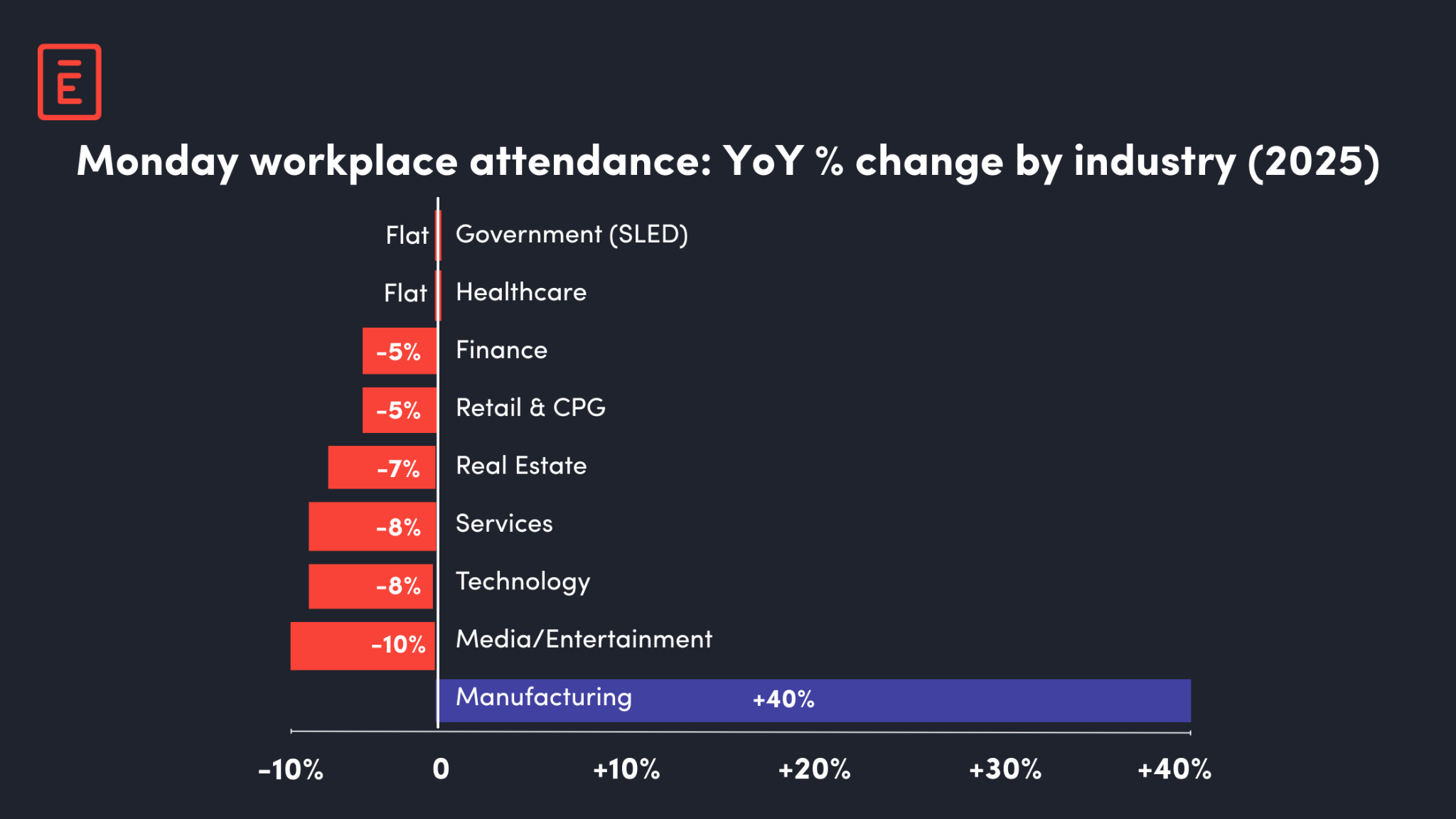
- Manufacturing defies the Monday slowdown: Monday attendance increased more than 40% year over year.
Trend 4: Workplace attendance shifts as companies scale
Startups sprint, enterprises ease in. The result is different attendance peaks depending on company size, and clearer signals for workplace teams planning what happens on-site.
Key trends to watch:
- Across small and mid-sized organizations (0–999 employees), Tuesday consistently emerges as the peak in-office day. These companies tend to concentrate collaboration, meetings, and in-person work early in the week, creating a clear anchor point before flexibility increases later on.
- Large enterprises tell a slightly different story. At organizations with 1,000+ employees, the peak shifts to Wednesday. This move later in the week likely reflects the added complexity of coordinating larger teams, distributed offices, and layered schedules, where attendance builds more gradually before reaching its high point.
Trend 5: Visitor activity follows its own rhythm
Visitor traffic behaves differently than employee attendance.
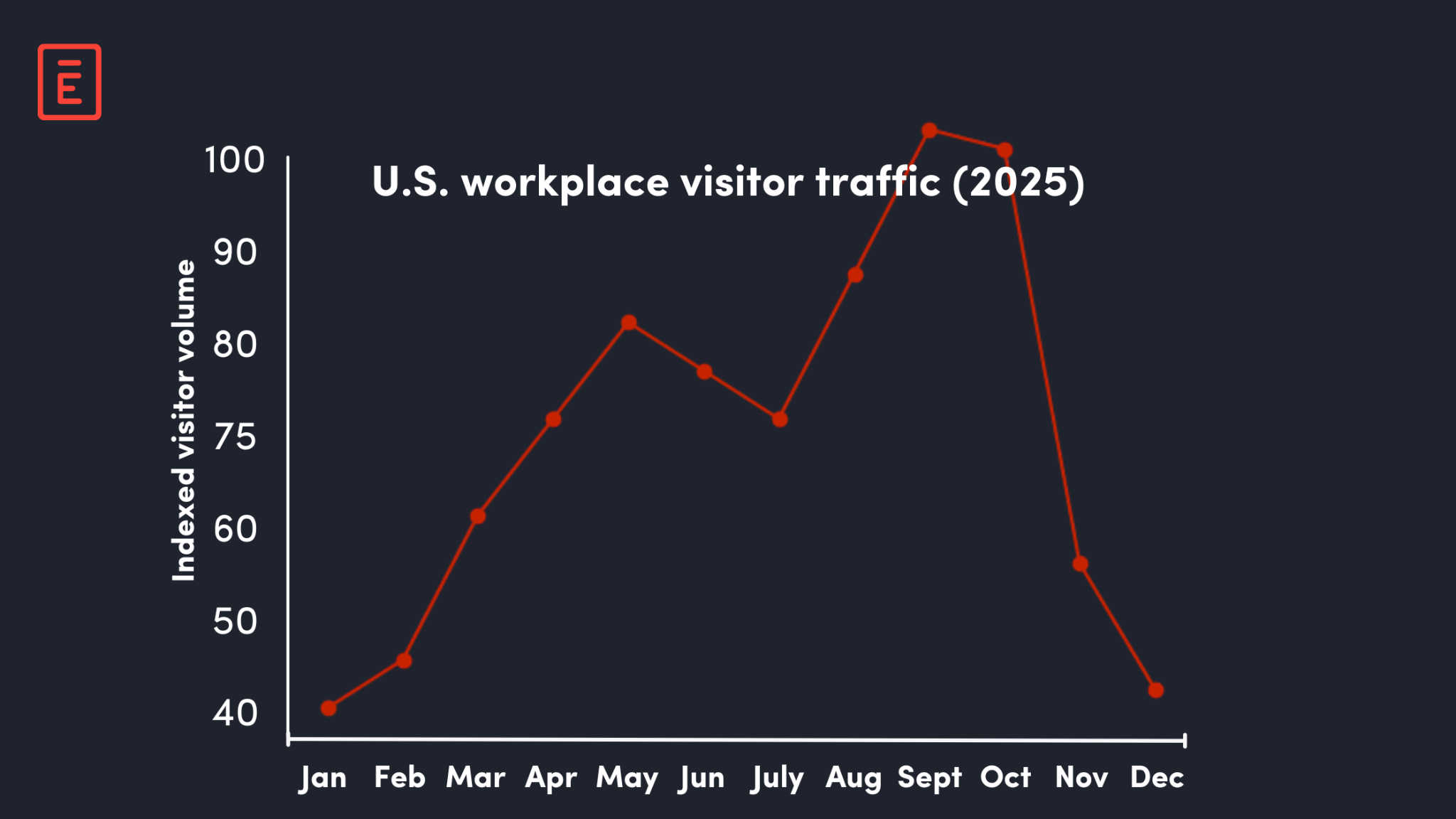
Key trends to watch:
- Fall is visitor season: September and October see the highest visitor volumes.
- Winter is consistently quieter: January and December are the slowest months.
- Visitor concentration varies by industry: Technology leads, followed by Professional Services, Manufacturing, and Finance.
In 2025, hybrid work has found a rhythm
After several years of trial and adjustment, organizations now show consistent, repeatable attendance rhythms by day, location, industry, and company size. Midweek in-office peaks, lighter Mondays, and quiet Fridays are no longer anomalies. These patterns show up across markets and industries, giving workplace teams a reliable foundation for planning space, staffing, security, and on-site experiences.
The next phase of hybrid work is not about changing behavior. It is about optimizing for it. In 2026, the most effective workplaces will be the ones designed around predictable peaks, flexible edges, and intentional in-person time; not a return to five evenly distributed days.
—
This post is part of our Data Snack Series. Check out past blogs for more workplace insights.
Touchdown: compliant visitor management. Learn how NFL's Washington Commanders ditched paper logs for compliant, real-time visitor tracking. Read the full story.
Read more
Envoy’s September 2026 releases help teams manage visitors with less manual work, streamline compliance reporting, and keep access systems in sync.
Learn how to measure conference room utilization, occupancy, no-shows, booking density, and more, and use the data to make smarter space decisions.
Envoy’s August 2026 releases introduce Envoy Response for emergency management, bringing emergency response into the same platform you already use for visitor and workplace management.

Envoy's July 2026 releases focus on workplace intelligence features like HRIS directory sync, workplace map file exports, and mailroom management improvements through the Developer API.

Envoy data across 300+ U.S. metros reveals the one morning the World Cup actually emptied the office, and it wasn't when you'd think.

Envoy Academy is back with a full refresh. Still free, still on-demand, and organized by role so admins get fluent in Envoy fast.