

How to build a fire evacuation plan for your business

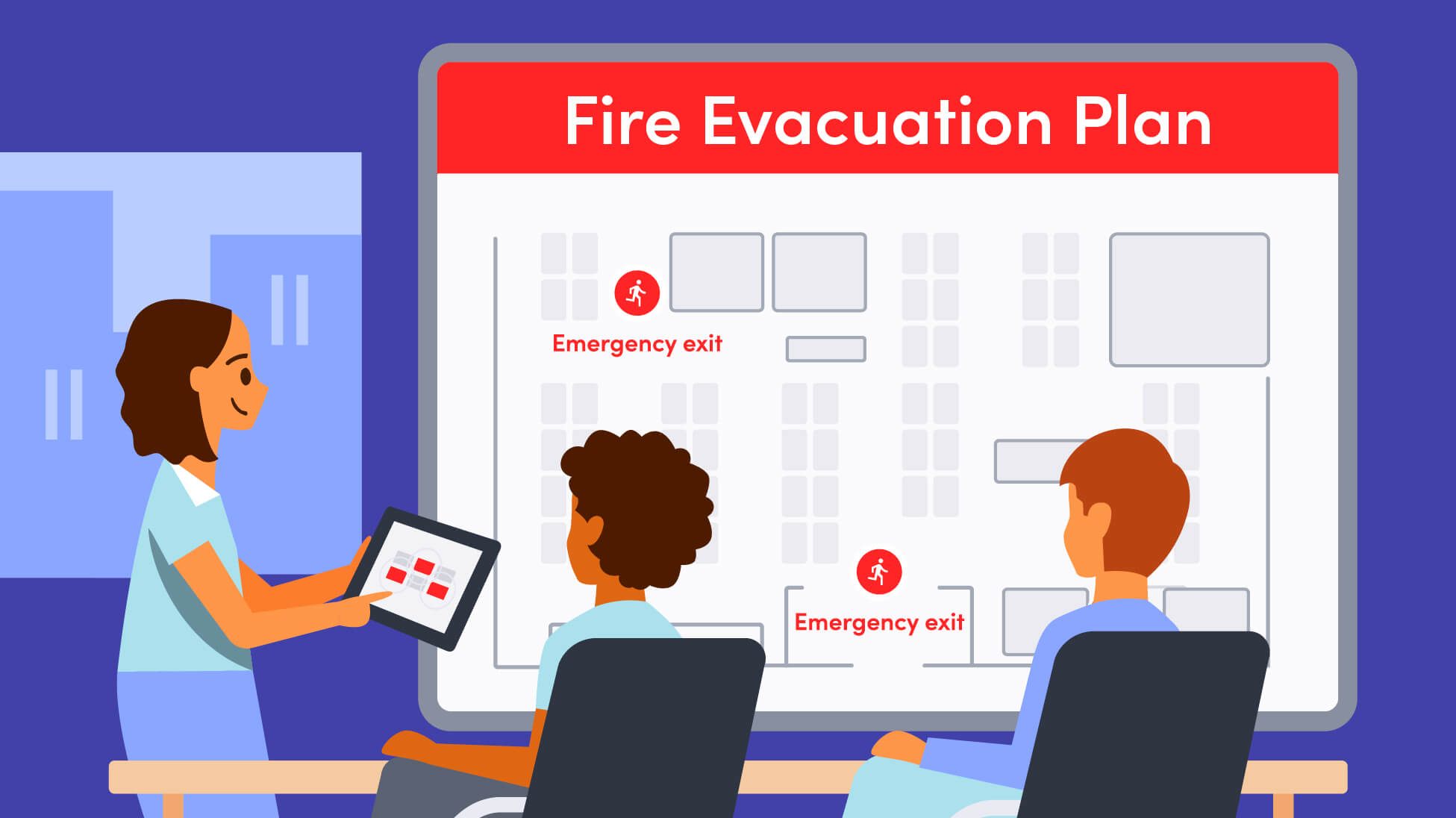
Most evacuation plans get the obvious part right: how people leave the building. The harder questions include: Where does everyone go? Who checks that they made it? What happens to visitors, contractors, or someone who needs help evacuating?
A good fire evacuation plan answers those questions, and more, before an alarm ever sounds.
Know what OSHA requires
Not every U.S. business is required to have a written emergency action plan. Under OSHA 29 CFR 1910.38, you need one when another OSHA standard requires it.
When that applies, businesses with more than 10 employees need to keep the plan in writing and make it available to employees. Smaller employers can explain the plan verbally, but OSHA still recommends emergency planning even when a written plan isn’t required.
NFPA 101: Life Safety Code also covers areas such as exits and emergency planning, but the rules that apply can vary by building type and local code. If you’re unsure, check with your local fire marshal or building management.
What your fire evacuation plan should include
OSHA sets minimum requirements for covered emergency action plans. For a fire-specific plan, these requirements should be turned into clear instructions your team can actually use.
Evacuation routes and exits
Map out a primary and backup way out from each part of the workplace, including accessible routes. Keep exits clearly marked and make sure paths stay clear.
Larger workplaces may need different routes for each floor, department, or work area rather than sending everyone toward the same exit.
Fire reporting and notification
Spell out how someone should report a fire and how the rest of the workplace will be notified.
Be sure your plan covers the building alarm as well as any additional communication channels you’ll use to reinforce instructions. OSHA also requires workplace alarm systems to clearly signal what employees should do. For example, an evacuation alert should be easy to distinguish from a shelter-in-place alert.
Muster points and accountability
Choose a safe muster point where people should gather after evacuating, away from the building and emergency response activity.
Then document how you’ll account for everyone there. This means employees as well as visitors, contractors, vendors, and anyone else who may be onsite. (OSHA recommends establishing a method for accounting for non-employees, too.)
Your accountability process should answer a few basic questions: Who runs roll call? What roster do they use? How is someone marked safe? What happens when someone is still unaccounted for?
Roles and responsibilities
Assign responsibility before anyone needs to make decisions under pressure. Your plan might name:
- An evacuation coordinator
- Floor or building leads
- Muster-point or accountability leads
- People assigned to assist with accessibility needs
- Someone responsible for emergency communications
- Backups for each critical role
OSHA requires employers covered by 1910.38 to designate and train employees to help with a safe and orderly evacuation.
Critical operations
If everyone should evacuate immediately, say so.
If certain employees need to shut down equipment or critical operations before leaving, document exactly who does what and when they should stop and evacuate themselves. OSHA requires these procedures when employees are expected to remain behind temporarily.
Rescue and medical duties
Document any rescue or medical duties assigned to employees and who is responsible for them. If your plan doesn’t expect employees to perform rescue or medical duties, make that clear as well. These responsibilities should only be assigned to people with the appropriate training.
Build the plan for the workplace you actually have
A single office is one thing. Plans become harder to manage when workplaces span several floors, buildings, tenants, or locations.
If your business has multiple sites, keep the overall structure consistent, but create a site-specific plan for each location. OSHA recommends that organizations with more than one worksite have an emergency action plan for each site because layouts, hazards, systems, routes, and contacts differ.
For multi-tenant buildings, coordinate with property management and the other organizations sharing the building. Clarify who controls the alarm, which exits and common areas people should use, where each group will muster, who communicates the all-clear, and how emergency responders receive accountability information. OSHA specifically recommends coordinating emergency plans with other companies or employee groups in the same building.
Don’t forget that your plan should also reflect accessibility and mobility needs rather than relying on one evacuation procedure for everyone.
Fire evacuation plan template: What to document
You can use this structure as a starting point for each workplace:
- Site information: Address, building or floor, emergency contacts, and plan owner
- Fire reporting: How employees report smoke, fire, or another emergency
- Alarm and notifications: How evacuation instructions are sent and who sends them
- Evacuation routes: Primary and alternate exits, maps, and accessible routes
- Muster points: Where each group gathers after leaving the building
- Accountability: How employees, visitors, and contractors are accounted for
- Response roles: Coordinators, floor leads, accountability leads, and backups
- Special duties: Critical shutdown, medical, rescue, or accessibility responsibilities
- All-clear and reentry: Who can authorize people to return
- Training and review: When the plan is reviewed, practiced, and updated
{{protip-1}}
Test your plan with a fire drill
Once the plan is written, put it into practice. A workplace fire drill can show you where routes create bottlenecks, whether alerts reach everyone, how long accountability takes, and whether assigned roles work as expected.
Use what you learn to update the plan and strengthen your broader emergency management program. OSHA recommends reviewing emergency plans whenever responsibilities, workplace layouts, equipment, hazards, or procedures change.
Support evacuation accountability with Envoy
A written plan defines the process. Evacuation management is what helps teams put it into action, reaching the right people, accounting for everyone onsite, and keeping the response coordinated as people move to safety. Envoy Response can support that process:
- Reach the right people. Use live presence and location data to send evacuation alerts to affected employees, visitors, and contractors across multiple channels.
- Know who needs to be accounted for. Visitor check-ins and workplace presence data give teams a more current roster than an employee directory alone.
- Manage the incident from one place. Track who’s safe, run digital roll calls at muster points, follow up with anyone who hasn’t checked in, and keep response teams aligned as the evacuation unfolds.
- Keep a record of the response. Envoy automatically captures notifications, responses, status updates, and timestamps for after-action review and reporting.
A fire evacuation plan is one part of a broader workplace response strategy. For help planning across different emergencies, see our guide to building an emergency preparedness plan.
Ready to learn more about Envoy Response? Schedule a demo today.
Fire evacuation plan FAQs
What is a fire evacuation plan?
A fire evacuation plan explains how people should leave the workplace safely during a fire or similar emergency. It covers routes and exits, alerts, assigned roles, muster points, accountability, and any special duties employees need to perform.
Does OSHA require businesses to have a written fire evacuation plan?
Not every business is required to have one. OSHA 29 CFR 1910.38 requires an emergency action plan when another applicable OSHA standard calls for it. When the standard applies, the plan generally must be written, although employers with 10 or fewer employees may communicate it orally.
What should a fire evacuation plan include?
A fire evacuation plan should cover how fires are reported, alarm and notification procedures, evacuation routes and exits, muster points, employee accountability, assigned roles, critical-operation shutdown procedures, and any rescue or medical duties.
It should also explain how visitors, contractors, and people with accessibility needs will be handled.
How often should a fire evacuation plan be updated?
Review the plan whenever your workplace changes in a way that could affect evacuation. That might include new layouts, exits, equipment, hazards, employee responsibilities, or contact information. OSHA also requires covered employees to review the plan when it is developed and when their duties or the plan itself changes.
How do you account for visitors during a fire evacuation?
Include visitors and contractors in the same accountability process as employees. Keep an up-to-date record of who is onsite, direct them to the appropriate muster point, and include them in roll call so response teams know who is safe and who may still need assistance.
Want a fill-in version? Use our free workplace evacuation template to document routes, muster points, responsibilities, visitor procedures, and more.
Read more

This guide covers how visitor management supports FISMA, which NIST controls apply, and what your team needs to document along the way.

In this guide, we’ll break down how cloud digital signage works, how it compares with on-premise signage, cost factors, and what to look for in a solution.

Learn how to support ITAR compliance with visitor screening, access approvals, onsite controls, and records that document each visit.

Compare leading mass notification vendors, their best-fit use cases, and key tradeoffs. Learn what to evaluate before choosing a system.

New Envoy research reveals where physical security gaps emerge and whether organizations can prove their controls are working.
Learn how to run a workplace tornado drill, choose safer shelter areas, account for everyone onsite, and improve your emergency response plan.